
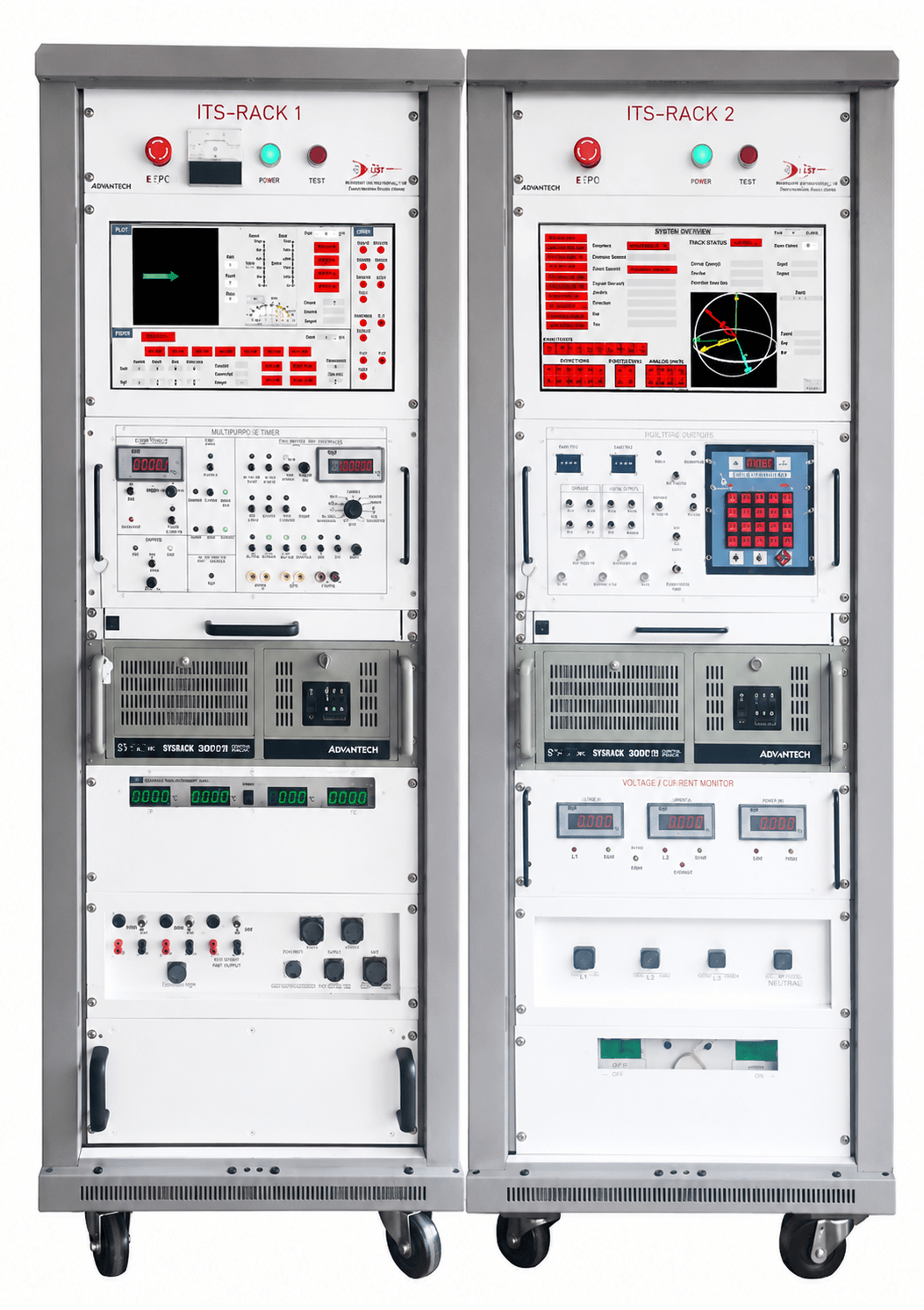
Why custom ATE
Catalogue instruments test parameters. ATE tests your assembly.
A bench multimeter measures voltage. It does not know what your unit is supposed to do, in what sequence, under what conditions, or what result counts as a pass. For a critical assembly, the gap between those two things is where escapes happen. Custom test equipment closes it: the test sequence, the limits, the fixture and the report are built around one assembly, so the operator presses start, and the system decides.
High throughput, low human error
Automated execution with minimal operator intervention. Repeatability stops depending on who is on shift.
Built for non-standard testing
Designed for critical assemblies where off-the-shelf equipment simply cannot perform the test.
Scalable architecture
Upgradeable as requirements evolve, so the system is not obsolete the first time the test spec changes.
Operation without a manual
Interfaces designed for minimal training, with custom report generation and storage for large volumes of results.
Rugged where it needs to be
Portable and battery-operated configurations for field and forward-area use.
Traceable by default
Self-test at startup, preset and user-configurable conditions, and stored results for audit and review.
Three categories
Three ways to build a test system.
The choice is driven by test speed, data complexity, budget, and sometimes by what your people were trained on. Most requirements resolve to one of these within the first conversation.
A · Manual / analog
Built to match the training your operators already have.
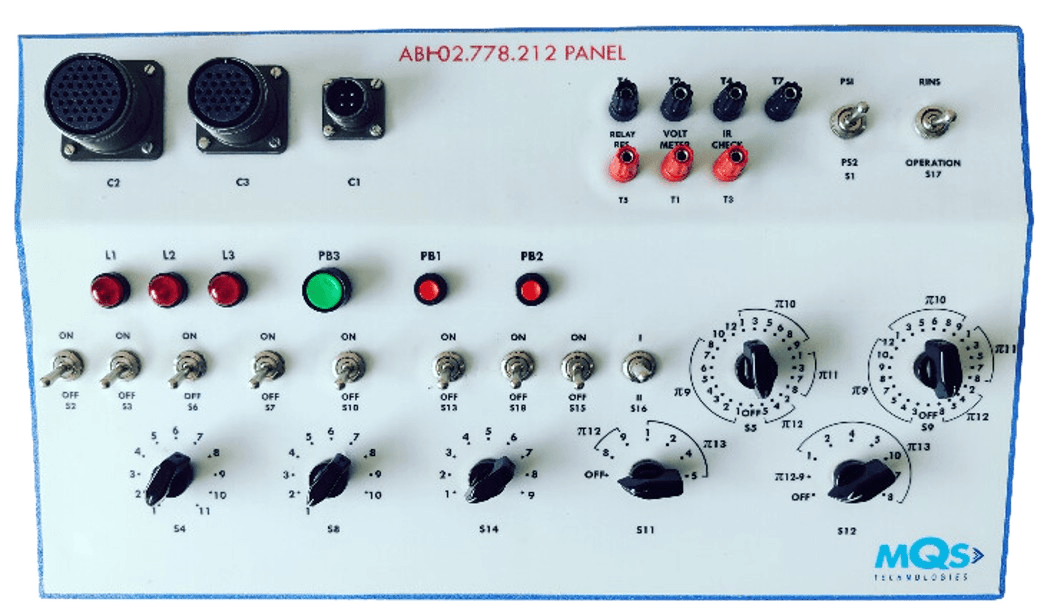
User-operated equipment following a documented procedure: the operator sets inputs on toggle or rotary switches, reads voltage, current and frequency, and prepares the test report. These remain the traditional test systems in defence depots, specified where continuity with existing training matters.
IMG-02 · Launcher test panel, one of eight panels in a card-level and system-level test suite. The front-panel layout deliberately replicates the original equipment so trained operators need no retraining.
- Best for
- Depot and field use where operators are already trained on legacy equipment
- Operator role
- Sets inputs by switch, reads meters, records results
- Interface
- Toggle and rotary switches, analogue meters
- Output
- Manual test report
- Choose when
- Continuity with legacy equipment matters more than automation
B · Microcontroller-based
Embedded testing that travels to the unit.
Embedded test systems offered as a cost-effective package, designed for higher duty cycles and ease of operation. A typical system pairs an LCD or touch screen with a membrane keyboard, and connects to the unit under test through custom connectors or a mechanical enclosure suited to its form factor.
- Best for
- Cost-effective embedded testing at higher duty cycles
- Operator role
- Follows on-screen prompts; system evaluates
- Interface
- LCD or touch screen with membrane keypad
- Output
- On-board storage, optional USB printer
- Choose when
- The test sequence is well defined and unit count is high
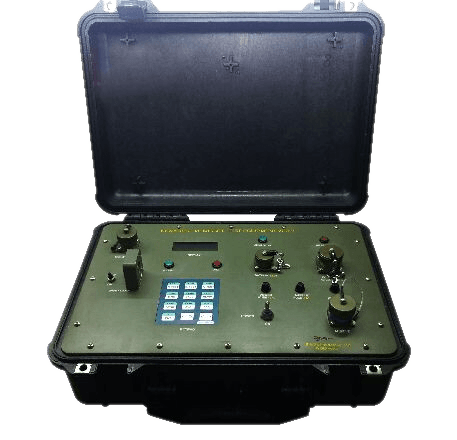
IMG-03 · Portable field test system in a ruggedised case, battery powered for standalone operation, generating commands, measuring response time and displaying a PASS / FAIL verdict against preset limits.
C · PC-based (LabVIEW)
When you need to see the data, not just the verdict.
Workstation-driven systems for high-speed testing and complex data capture, combining analog and digital measurement sources with real-time data acquisition, visualization and custom software.
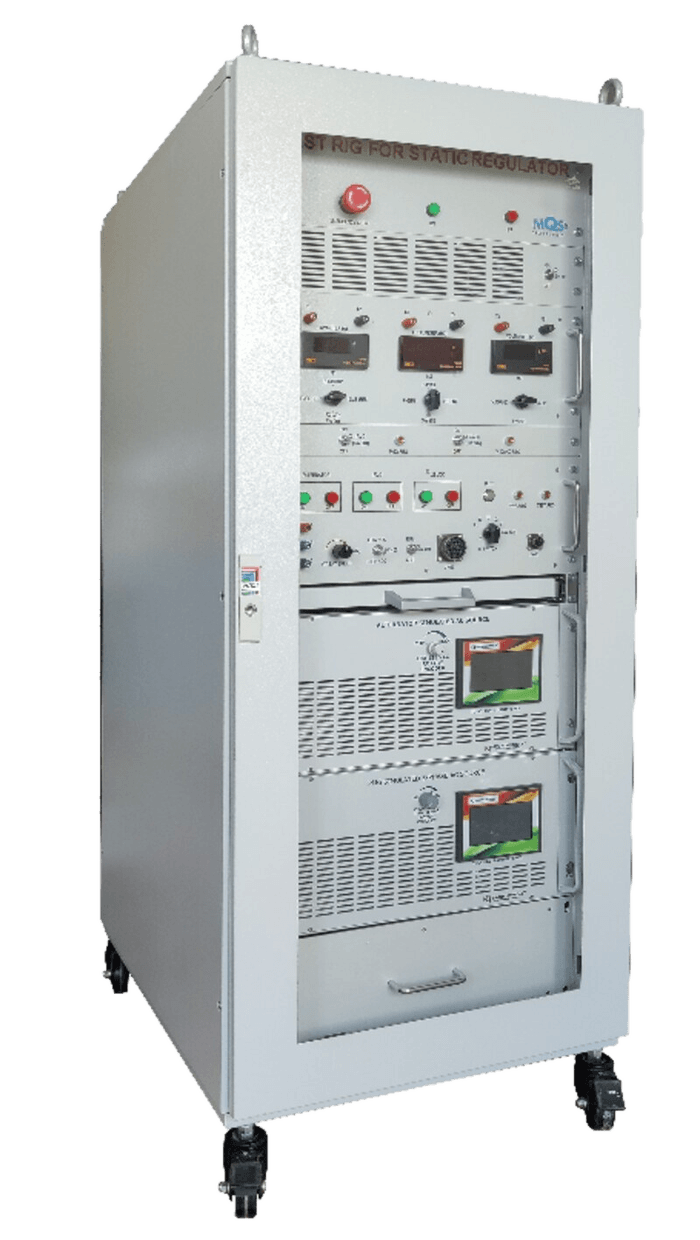
IMG-04 · Static regulator test rig, a cabinet system for functional verification of voltage and frequency regulation under controlled laboratory conditions.
- Best for
- High-speed testing and complex data capture
- Operator role
- Starts the sequence; system evaluates and logs
- Interface
- Full workstation GUI with real-time visualization
- Output
- Custom reporting, large result sets, export
- Choose when
- You need to see the data, not just the verdict
Systems built
What we have designed and delivered.
Each entry is a system MQS has built and delivered. Described by test function rather than by platform or customer, in line with the confidentiality our defence customers expect.
Aerospace test systems
Three systemsAlternator control & protection test rig
Voltage regulation, frequency regulation, current control and protection response, under simulated aircraft electrical conditions.
Static voltage regulator test rig
Voltage and frequency regulation of a 12 kVA three-phase alternator regulator, tested statically by substituting an equivalent AC source for the permanent magnet generator.
Duct temperature sensor test rig
Sensor output across a temperature range, with the sensor immersed in a temperature-controlled bath of aviation turbine fuel to replicate its real operating environment.
Defence test systems
Six systemsPortable missile checkout equipment (KMTE)
Final pre-firing checkout in the field: generates course and pitch commands, measures response time, and compares results against preset limits to display PASS or FAIL.
Launcher test panel suite
Eight panels covering card-level and system-level testing, fault isolation, calibration and final acceptance of launcher electronics.
Fire-control sighting test stand
Electrical parameters of the primary fire-control and sighting device of a main battle tank, verified before integration and field deployment.
Spin test equipment
Rotational speed at which fuze segment-lock shutters open, measured optically at speeds to 8,000 RPM and read out by an ARM-based controller.
Wire harness tester
Continuity, isolation resistance and insulation strength for airborne applications.
Gyro test rack
Drift parameters and stabilization rate for gyro gimbal assemblies.
One system named in full
Konkurs M Missile Test Equipment
The Konkurs M Missile Test Equipment (KMTE) can be named openly, because it was launched publicly by the Hon’ble Defence Minister in August 2023. That launch is a matter of public record, and it is the single strongest credential in the ATE portfolio: an indigenous test system, recognised at ministerial level, built for use at forward locations.
Standard capabilities
Included in every system we build.
Self-test at power-on
The system verifies itself before it verifies your assembly, so a fault in the tester is never mistaken for a fault in the unit.
Preset and user-defined conditions
Standard test conditions stored as presets, with room for the operator to configure where the process requires it.
Built-in result storage
Hundreds to thousands of test results retained on the system, available for recall and review.
Custom report generation
Reports formatted to your documentation requirement, not to a generic template.
Applications
Where MQS test equipment is used.
Aircraft electrical and sensor systems
Alternator control and protection, voltage regulation, temperature sensing, verified under simulated aircraft conditions before installation.
Assemblies where test coverage is a safety requirement
Launcher electronics, fuzes, guidance sub-assemblies and integration-stage testing, validated at build and re-validated through maintenance.
Production testing where cycle time decides output
Module and system fault diagnosis, and high-throughput production testing where repeatability and speed determine line performance.
How it works
A custom system is a project, not a purchase order.
Define
Share the assembly, the parameters to verify, the throughput and the environment it will be tested in.
Architect
We propose a category and scope: manual, microcontroller or PC-based, plus fixturing, interfaces and reporting.
Build & validate
Design, manufacture and in-house validation against your acceptance criteria before dispatch.
Deploy & support
Installation, commissioning, operator familiarisation, and support through the life of the system.
Talk to us
Have a test requirement nothing on the market covers?
Tell us the assembly, the parameters you need to verify and where it will be tested. Our engineers will propose a category and a scope, and will say so if a standard instrument would do the job.